The Traveling Salesman Problem (TSP)
Intuitively, the TSP is the problem of a salesman who, starting from his home town, wants to find the shortest possible trip through a given set of customer cities and return home, visiting each city exactly once. More formally, it can be represented by a complete weighted graph G = (V, E), with V the set of nodes representing the cities and E the set of edges fully connecting them.
Each edge is assigned a value  , the length of edge
  — that is, the distance between cities i and j, with
  . The TSP is the problem of finding a minimum-length Hamiltonian cycle of the graph. In symmetric TSPs the distance between two cities is independent of the direction of traversal, that is,
  for every pair of nodes.
An arc set  is a solution of the TSP if it is a simple cycle of length
  in G.
in G.
The objective function of the TSP is
 , where

subject to the degree constraints and subtour-elimination constraints:

The figure below shows a typical TSP input (a set of cities) and its optimal tour.
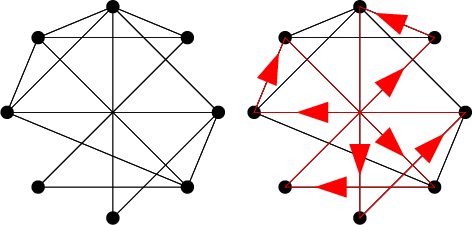
The TSP is the special case of the VRP with a single uncapacitated vehicle, and every VRP route is a TSP tour over the depot plus its assigned customers — which is why TSP methods (2-opt, 3-opt, Lin–Kernighan) are at the core of most VRP improvement heuristics.
See also: Hamiltonian Cycle Problem · VRP formulation · P and NP classes