The Bin Packing Problem (BPP)
The problem consists of packing a set of items into a number of bins such that the total weight, volume, etc. of each bin does not exceed a maximum value. More precisely, we define a bin packing problem (BPP) as follows:
- we are given a finite set of items, each of which has a weight;
- there are precedence constraints between items, such that we incur a (possibly infinite) cost when item j follows item i;
- an ordered group is an ordered subset of items such that:
- the total weight of the ordered group does not exceed the bin capacity;
- no cost between adjacent items in the group is infinite;
- the primary goal is to create a feasible solution with the minimum number of ordered groups;
- when two solutions use the same number of ordered groups, the one with the minimum aggregate cost is chosen.
Mathematically, the problem can be formulated as follows: given a finite set of elements 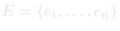 with associated weights
 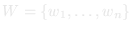 such that
 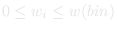 , partition
  into
into  subsets such that the sum of the weights in each part is at most
  and is minimum.
A typical input for the BPP and its corresponding output are shown in the figures below.
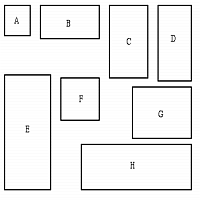
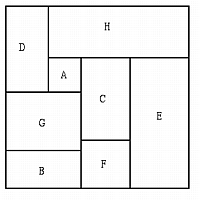
The BPP is the "loading side" of vehicle routing: checking whether the customers assigned to a route can be served by a single vehicle is exactly a bin packing feasibility question, and minimizing the number of vehicles in the CVRP is a bin packing objective. The BPP is NP-hard.
See also: Capacitated VRP · Generalized Assignment Problem · P and NP classes