Tabu Search
The basic concept of Tabu Search (TS) as described by [Glover 1986] is a metaheuristic superimposed on another heuristic. TS explores the solution space by moving at each iteration from a solution s to the best solution in a subset of its neighborhood N(s). Contrary to classical descent methods, the current solution may deteriorate from one iteration to the next. Thus, to avoid cycling, solutions possessing some attributes of recently explored solutions are temporarily declared tabu or forbidden. The duration that an attribute remains tabu is called its tabu tenure and it can vary over different intervals of time. The tabu status can be overridden if certain conditions are met; this is called the aspiration criterion and it happens, for example, when a tabu solution is better than any previously seen solution.
The resulting tendency to deviate from a charted course might be regarded as a source of error, but can also prove to be a source of gain. The tabu method operates in this way with the exception that new courses are not chosen randomly. Instead the tabu search proceeds according to the supposition that there is no point in accepting a new solution unless it is to avoid a path already investigated. This ensures new regions of a problem's solution space will be investigated, with the goal of avoiding local minima and ultimately finding the desired solution.
The initial solution is typically created with some cheapest insertion heuristic. After creating an initial solution, an attempt is made to improve it using local search with one or more neighborhood structures and a best-accept strategy. Most of the neighborhoods used are well known and were previously introduced in the context of various construction and improvement heuristics.
A typical algorithm for TS is described below:
S = InitialSolution() // S is current solution
S = LocalSearch(S)    // Make sure we start at a local min
B = S                 // B is the best solution
while not StoppingCondition() do
	moves = RankMoves(S)
	moved = false
	while not moved do
		m = head(moves)
		if IsNotTabu(m) then
			Perform(m)
			moved = true
			InsertInTabuList(m)
			if O(S) < O(B) then
				B = S
return B
Most of the proposed tabu searches use specialized diversification and intensification strategies to guide the search.
| Authors | Year | Initial Solution | Neighborhood Operators | Route min. | Notes |
|---|---|---|---|---|---|
| Garcia et al. | 1994 | Solomon's I1 heuristic | 2-opt*, Or-opt | Yes | Neighborhood restricted to arcs close in distance |
| Rochat et al. | 1995 | Tabu search | 2-opt | No | Adaptive memory |
| Carlton | 1995 | Insertion heuristic | Relocate | No | Reactive tabu search |
| Potvin et al. | 1996 | Solomon's I1 heuristic | 2-opt*, Or-opt | Yes | Neighborhood restricted to arcs close in distance |
| Taillard et al. | 1997 | Solomon's I1 heuristic | CROSS | No | Soft time windows, adaptive memory |
| Badeau et al. | 1997 | Solomon's I1 heuristic | CROSS | No | Soft time windows, adaptive memory |
| Chiang et al. | 1997 | Modification of Russell (1995) | l-interchange | No | Reactive tabu search |
| De Backer et al. | 1997 | Savings heuristic | Exchange, relocate, 2-opt*, 2-opt, Or-opt | No | Constraint programming used to check feasibility of moves |
| Brandão | 1999 | Insertion heuristic | Relocate, exchange, GENI | No | Neighborhoods restricted to arcs close in distance |
| Kelly et al. | 1999 | Tabu Search | exchange, local route improvement, 3-opt | Yes | ------- |
| Schulze et al. | 1999 | Solomon's I1, parallel I1 and savings heuristic | Ejection chains, Or-opt | Yes | Generated routes stored in a pool |
| Tan et al. | 2000 | Insertion heuristic of Thangiah (1994) | l-interchange, 2-opt* | No | ------- |
| Lau et al. | 2000 | Insertion heuristic | Exchange, relocate | No | Constraint based diversification |
| Cordeau et al. | 2001 | Modification of Sweep heuristic | Relocate, GENI | No | ------- |
Here, we will describe three different algorithms for TS:
Granular Tabu
Granular Tabu Search (GTS) is a very promising concept. It was introduced by [Toth and Vigo 1998] and has yielded excellent results on the VRP. The main idea behind GTS stems from the observation that the longer edges of a graph only have a small likelihood of belonging to an optimal solution. Therefore, by eliminating all edges whose length exceeds a granularity threshold, several unpromising solutions will never be considered by the search process. Toth and Vigo suggest using  , where
  is a sparsification parameter typically chosen in the interval [1.0, 2.0], and
  is the average edge length of a solution obtained by a fast heuristic. If
 ![β in [1, 2]](../Latex-formules/Tabu4.png) , then the percentage of remaining edges in the graph tends to be in the 10%–20% range. In practice the value of is dynamically adjusted whenever the incumbent has not improved for a set number of iterations, and periodically decreased to its initial value. Neighbor solutions are obtained by performing a limited number of edge exchanges within the same route or between two routes. The authors propose a procedure capable of examining all potential exchanges in
, then the percentage of remaining edges in the graph tends to be in the 10%–20% range. In practice the value of is dynamically adjusted whenever the incumbent has not improved for a set number of iterations, and periodically decreased to its initial value. Neighbor solutions are obtained by performing a limited number of edge exchanges within the same route or between two routes. The authors propose a procedure capable of examining all potential exchanges in  time, where
  , and I is a set of important edges such as those incident to the depot or belonging to high quality solutions.
The Adaptive Memory Procedure
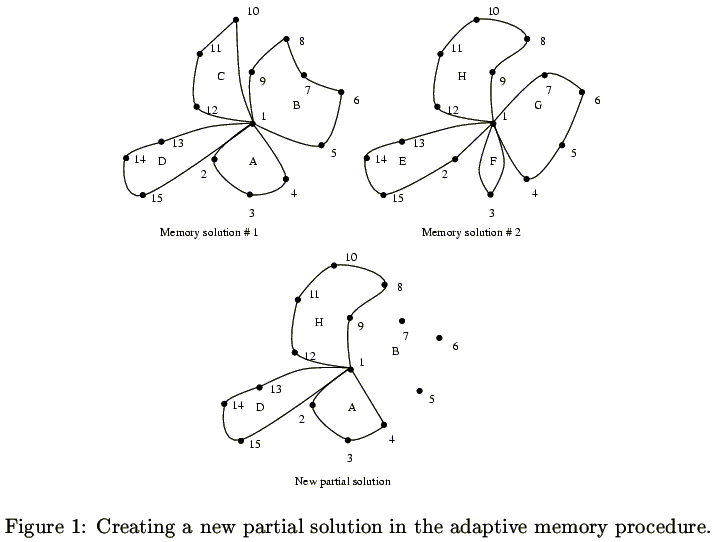
One of the most interesting developments to have occurred in the area of TS in recent decades is the concept of adaptive memory developed by [Rochat and Taillard 1995]. It is mostly used in TS, but its applicability is not limited to this type of metaheuristic. An adaptive memory is a pool of good solutions that is dynamically updated throughout the search process. Periodically, some elements of these solutions are extracted from the pool and combined differently to produce new good solutions. When selecting these routes, care must be taken to avoid including the same customer twice in a solution. This restriction means that the selection process will often terminate with a partial solution that will have to be completed using a construction heuristic. In the example depicted in the figure below, extracting routes A, D and H from a memory of two solutions results in a partial solution. Rochat and Taillard have shown that the application of an adaptive memory procedure can enhance a search strategy. This enabled them to obtain two new best solutions on the 14 standard VRP benchmark instances.
Kelly and Xu
In this case, [Kelly and Xu 1996] considered swaps of vertices between two routes, a global repositioning of some vertices into other routes, and local route improvements. The global repositioning strategy solves a network flow model to optimally relocate given numbers of vertices into different routes. Approximations are developed to compute the ejection and insertion costs, taking vehicle capacity into account. Route optimizations are performed by means of 3-opt exchanges and a TS improvement routine. The algorithm is governed by several parameters which are dynamically adjusted through the search. A pool of best solutions is memorized and periodically used to reinitiate the search with new parameter values. Overall, this algorithm produced several best known solutions on benchmark instances, but it is fair to say that it is not as effective as some other TS implementations. It tends to require a considerable computational effort, and properly tuning its many parameters can be problematic.