Simulated Annealing
Simulated Annealing (SA) is a stochastic relaxation technique, which has its origin in statistical mechanics. It is based on an analogy with the annealing process of solids, where a solid is heated to a high temperature and gradually cooled in order for it to crystallize in a low energy configuration. SA can be seen as one way of trying to allow the basic dynamics of hill-climbing to also escape local optima of poor solution quality. SA guides the original local search method in the following way. The solution S′ is accepted as the new current solution if  , where
 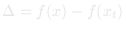 . To allow the search to escape a local optimum, moves that increase the objective function value are accepted with a probability
  if
if  , where T is a parameter called the "temperature". The value of T varies from a relatively large value to a small value close to zero. These values are controlled by a cooling schedule, which specifies the initial temperature and the temperature values at each stage of the algorithm.
At iteration t of Simulated Annealing, a solution x is drawn randomly in  . If
. If  , then
  is set equal to x; otherwise

where  is usually a decreasing function of t and of
  . It is common to define as .
There are three common stopping criteria:
- The value
 of the incumbent
  has not decreased by at least
  for at least
  consecutive cycles of T iterations;
 - The number of accepted moves has been less than
 of T for
  consecutive cycles of T iterations;
  of T iterations have been executed.